Your HMIS Data, Connected
When your HMIS, health, and housing data live in separate systems, you're always missing part of the picture.
Data
Building a Trusted Foundation: The Open Path Data Warehouse
Ending homelessness requires coordination across housing programs, healthcare, behavioral health, and local government. But in most communities, these systems don't talk to each other.
The result is fragmented reporting, manual reconciliation, and leadership making decisions based on incomplete pictures. Your HMIS has data. Your health system has data. Your housing pipeline has data. Somewhere in between, the full story gets lost.
Creating a Single Source of Truth
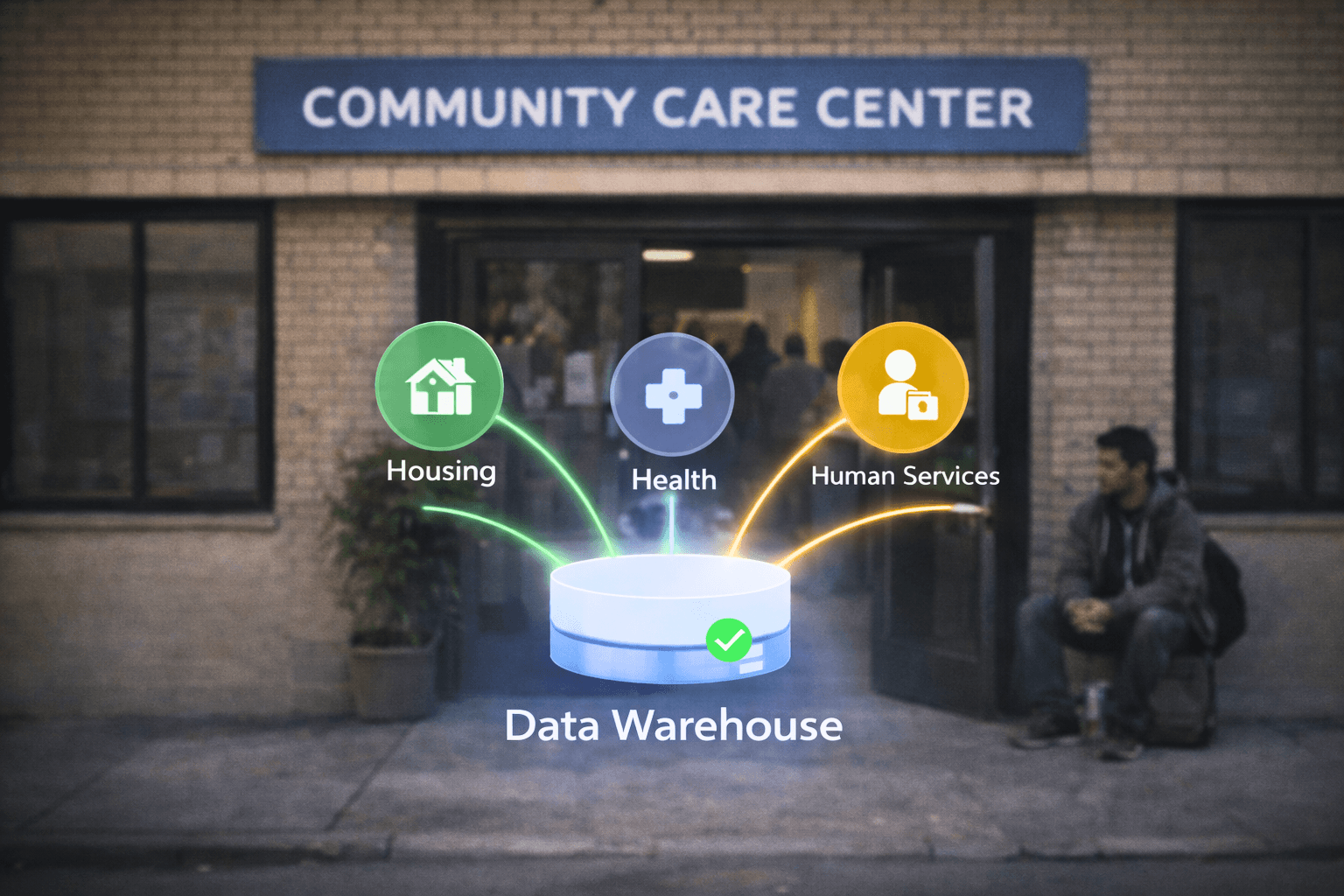
The OpenPath Data Warehouse centralizes program and operational data into one secure, governed system. HMIS records. Health data. Human services data. External datasets pulled from partner agencies. All of it lands in one place — deduplicated, matched, and trusted.
This matters because the alternative is constant reconciliation. Teams spending hours before board meetings trying to explain why three reports show three different numbers. Leadership asking questions that nobody can answer confidently. Analysts who know the data is incomplete but can't say by how much.
A centralized warehouse doesn't just save time. It changes what questions you can ask — and how quickly you can answer them.
Secure Data Sharing for Real Coordination
Bringing data together sounds simple. In practice, it requires careful handling of consent, privacy, and legal data sharing agreements.
OpenPath's warehouse supports automated data ingestion — transformation, matching, and loading that runs without manual intervention. Extensive user permission settings and client consent models let communities define exactly what gets shared, with whom, and under what conditions. Communities can align their data sharing policies with HIPAA, state law, and local agreements without building custom infrastructure from scratch.
The security isn't an afterthought. It's what makes the coordination possible in the first place.
Moving Beyond the Silos
Here's what nobody tells you about data silos: the problem isn't that you don't have enough data. It's that the data you have lives in places that don't connect.
When agency staff can see a client's comprehensive history — housing episodes, service history, healthcare contacts — they make better decisions. They understand vulnerability more clearly. Referrals get smarter. Resources go where they're actually needed.
The warehouse is what makes that possible. Stop juggling spreadsheets. Stop reconciling numbers after the fact. Start tracking real outcomes across the full care continuum — and building a foundation that can actually support strategic decisions.